
Restaurants & Takeaways/6 min read
Could your restaurant earn more before it expands?
Compare operating changes, refurbishment and expansion to see which could leave more after extra costs, without overlooking disruption or cash needs.
Perspective · GIC Capital · Published 7 November 2026
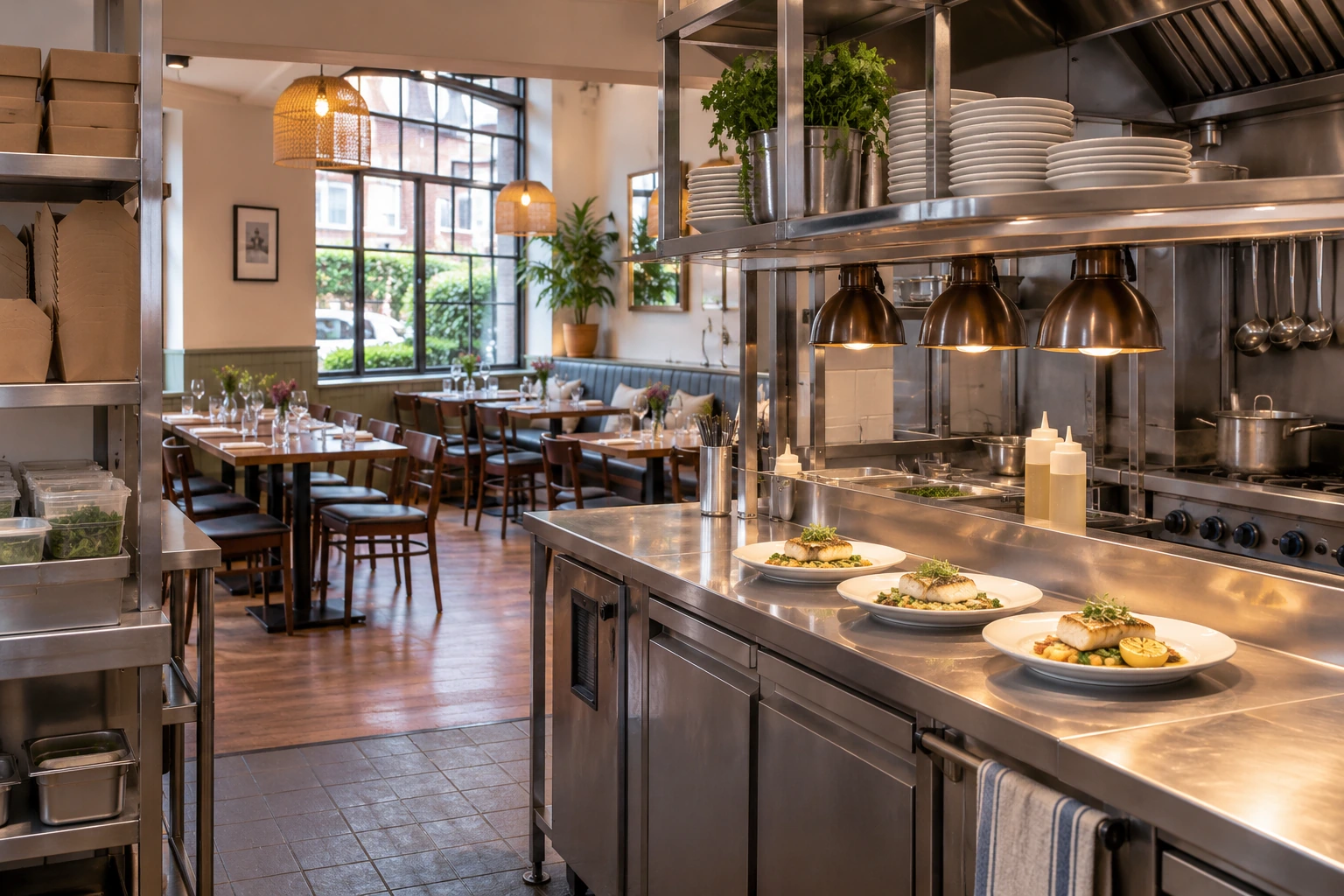
A restaurant can be fully booked and still have a weak investment case. The issue may be the kitchen pass, service timing, contribution per cover or the working capital needed for a second site. Before investing in more space, identify which constraint prevents a worthwhile customer visit from becoming collected cash. This perspective develops a kitchen-upgrade example, exposes the recurring costs behind a headline payback and sets out a practical way to compare investment with operational improvement.
Fully booked at what point in the service?
A busy Saturday evening does not establish that the restaurant needs another site. Examine the trading pattern by day and service. An empty weekday lunch and a congested weekend dinner are different problems. Record enquiries declined, bookings accepted, customers seated, covers served, cancellations and waiting time. A waiting list that rarely converts may be a weaker signal than repeat customers unable to book.
Trace the service from booking to payment. Extra seats may add little if the kitchen cannot produce another order at the required standard. Faster cooking may add little if front-of-house staffing, table clearing or customer dwell time determines turnover. Define the bottleneck using observations from several comparable services, including a quiet period.
Calculate the contribution of the extra customer
Start with the extra sales reasonably attributable to the change, then deduct the costs those sales cause. For dine-in service, this may include ingredients, payment charges and genuinely incremental labour. For takeaway or delivery, assess packaging, commissions, promotions and refunds separately. A higher-priced delivery order can make a different contribution from a dine-in cover.
Agree the definition before using the result in an investment model. If extra staff are required for a whole shift, that is a step in cost, not necessarily a cost varying smoothly with each cover. Do not deduct the same labour both in the £18 contribution assumption below and again as an extra fixed cost. Sales figures and margin figures must use a consistent treatment of VAT.
Good stock and supplier management also sit within the operating case. The Food Standards Agency’s food-safety guidance covers procedures, supplier checks and traceability. [1] An investment forecast does not establish that a revised process is safe or workable; involve the responsible operational specialists.
Work through the kitchen-upgrade calculation
Suppose a £24,000 kitchen upgrade could support 15 extra covers weekly at £18 contribution per cover over 48 weeks. Incremental annual contribution would be £12,960 before maintenance, disruption and financing; a simple pre-cost payback is approximately 1.85 years. If actual additional covers are five weekly, the equivalent payback exceeds five years.
| Additional covers each week | Annual contribution: £18 × covers × 48 weeks | £24,000 divided by contribution |
|---|---|---|
| 5 | £4,320 | 5.56 years |
| 10 | £8,640 | 2.78 years |
| 15 | £12,960 | 1.85 years |
These are simple pre-cost paybacks. They do not include a financing schedule, tax, the time value of money or resale value. The assumption is that the covers are additional to the business, are collected at the modelled price and persist through 48 trading weeks. Moving existing customers to a different service does not automatically create additional annual demand.
Add the costs that a sales-only case leaves out
Now extend the same hypothetical example with £1,800 of annual maintenance and £3,600 of additional annual staff cost. These are chosen assumptions, not restaurant-sector benchmarks. They sit outside the £18 contribution per cover, and therefore reduce the cash contribution available to recover the equipment investment.
| Additional covers weekly | Contribution after £5,400 annual added costs | Simple payback before financing and tax |
|---|---|---|
| 5 | −£1,080 | No positive payback in this model |
| 10 | £3,240 | 7.41 years |
| 15 | £7,560 | 3.17 years |
At these assumptions, 6.25 additional covers a week cover the added annual costs; seven whole covers would exceed that operating threshold. Recovering £24,000 within four years would require approximately 13.19 additional weekly covers, or at least fourteen whole covers, before financing, tax and other omitted costs. This is a test of the assumptions, not a recommended investment hurdle.
Price disruption before ordering the equipment
Identify the supplier deposit, balance payment, installation period, training, waste during commissioning and any service closure. Put them on actual dates. Maintenance and extra payroll can begin before the additional customers arrive. Leave room for a slower start and a repair or installation delay, rather than assuming the first post-installation week delivers the mature forecast.
Measure a closure through the cash contribution lost after costs that would genuinely be avoided. Subtracting all lost revenue and also charging every normal variable cost can double count the damage. Conversely, assuming a closed restaurant has no wage, rent or utility commitments can understate the cash requirement. Have the finance team reconcile this bridge from trading records.
A total project budget is useful, but a dated cash plan identifies whether the rest of the restaurant can keep operating while the project is paid for. A year-one contribution surplus does not solve a payment due before launch.
Compare the smallest credible alternatives
An operational trial may involve changing booking intervals, preparation sequencing or service allocation. Targeted equipment may improve reliability or remove a measured bottleneck. Refurbishment may address customer comfort or positioning. A second site adds a different set of commitments: another premises, management attention, staffing and a separate local demand case.
Keep the demand assumptions consistent across the comparison. If a new menu, more effective marketing and equipment are introduced together, do not attribute the entire improvement to the equipment. Equally, include a credible no-investment case: continuing with unreliable equipment may carry downtime or maintenance costs that a simple comparison overlooks.
Compare alternatives on contribution, cash exposure, service quality, reversibility and management capacity. An option that improves the existing operation with less disruption can deserve investigation even when its headline revenue potential is lower.
Design a short trial that can change the decision
- Choose a defined service and record its current covers, contribution definition, staffing and bottleneck.
- Specify one operational change, its cost and the outcome that would justify continuing.
- Compare similar services and record changes in pricing, menu, promotions, weather or local events.
- Review service quality, complaints, waste and staff workload alongside the financial result.
- Use the observed range, rather than the best evening, to revise the investment and downside cases.
A small trial is not a controlled scientific experiment and may not establish causation. Its purpose is to replace a vague assertion with better operating evidence. If the key uncertainty is customer demand rather than throughput, a process test cannot close that gap on its own.
What should the next conversation contain?
Bring a brief that states the objective, the measured constraint, the options considered and the operating evidence still missing. Include the investment schedule, incremental contribution assumptions, recurring costs and lowest cash point. Ask which assumption would make the proposed investment unattractive; that question is often more useful than a target sales increase.
If a sound operating case creates a temporary cash need, GIC Capital can contribute a strategic perspective on the broad capital options and information required to explore them. Operational feasibility, food safety, accounting and tax need the appropriate specialists. The useful outcome may be a targeted upgrade, a longer trial, a phased project or no additional investment.
Sources and scope
Evidence checked on 7 November 2026. Market context and guidance can change. All worked business examples are hypothetical.
Would staging the investment reduce the cash you need?
Use the example to identify what you would need to check in your own business. If a material question remains, outline it for GIC. Your note stays in this tab until you review and choose to send an enquiry. Any engagement or introduction would be agreed separately.
The finder locates published material, not personalised advice.
General educational analysis. Figures are assumptions, not a valuation, personal recommendation, offer or eligibility assessment. Obtain appropriate specialist input before committing.