
Waste and resource operations/9 min read
Will the next waste contract leave more after processing and disposal?
Combine gate fees, accepted recovered material, residue costs and payment dates to see whether extra volume is worth taking on.
Perspective · GIC Capital · Published 7 November 2026
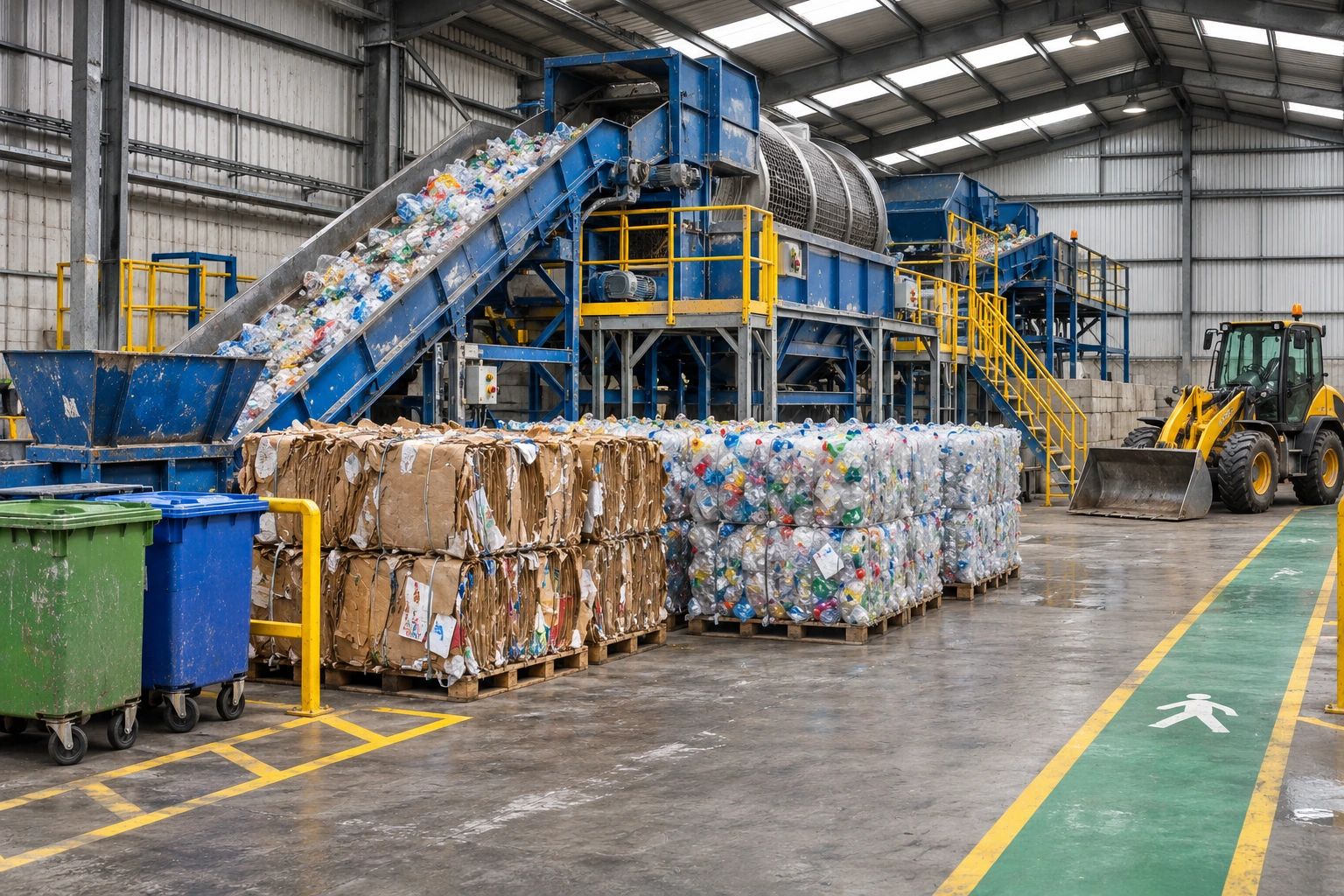
For commercial waste, recycling and resource-recovery operators comparing a new intake contract, sorting investment or additional shift. Incoming tonnes create a handling responsibility as well as potential income. The result depends on composition, recovery quality, residue routes, buyer acceptance and the dates on which receipts and payments occur. A gate fee can look attractive while the full material balance is weak. Start with the waste stream and its permitted route, then compare the net contribution from the whole batch. This example concerns a recycling facility; water and sewerage operators need a different treatment and service-performance model.
Follow every intake tonne to a credible destination
For the proposed stream, record the expected composition, contamination, moisture and measurement basis. Reconcile intake to recovered grades, residue, process losses and stock movements. Identify which outputs have an agreed buyer, which need further treatment and which incur disposal cost. A percentage labelled recovery is commercially incomplete until quality, acceptance and destination are clear.
Use actual sample and batch evidence where available. A clean demonstration load may not represent a mixed commercial stream over several months. Establish who carries the cost of non-conforming loads, rejected output, transport and additional testing. Confirm how weights, sampling and disputes will be handled before treating a quoted gate fee as dependable contribution.
Treat permissions and outlets as capacity constraints
Environment Agency guidance for England sets out the need to match waste activities to the appropriate permit or exemption and its conditions. [1] The duty-of-care code addresses authorised transfers and waste descriptions in its stated jurisdiction. [2] A sales forecast does not extend the site’s operating authority. Confirm the actual permitted stream, quantity, storage, treatment and conditions with the responsible team.
Recovered material with a buyer is not automatically a non-waste product. Check the applicable end-of-waste requirements and quality evidence rather than relying on its price or appearance. [3] Record whether each outlet receives waste or a product, and on what basis. The commercial model should preserve the required controls, analysis, documentation and transfer costs.
Keep physical limits visible: safe storage, fire and environmental controls, traffic, equipment uptime, skilled staff and available lawful outlets. A higher theoretical line speed may have little value if recovered bales or residue cannot leave on time. Do not solve an apparent capacity problem by assuming longer stock retention without checking the operating consequences.
A hypothetical 1,000-tonne recycling contract
Assume 1,000 intake tonnes carry an £80 per tonne gate fee. Saleable recovered material is 60% of intake and earns an illustrative £50 per tonne. Processing costs £45 per input tonne. The remaining 40% is residue, with an all-in disposal cost of £100 per residue tonne. Recovered output transport costs £15 per recovered tonne. The residue cost includes the applicable charges assumed for this example; no actual levy rate is asserted.
All figures are hypothetical and exclusive of VAT. The comparison is contribution before unchanged site overhead, added investment, financing and tax. Assume all recovered material in the table meets the agreed specification and is accepted by a lawful outlet. Actual storage, testing, rework and rejection costs must be added where relevant.
| 1,000-tonne batch | Base | Lower recovery | Lower recovery and price |
|---|---|---|---|
| Recovered yield | 60% | 50% | 50% |
| Recovered material price | £50/t | £50/t | £30/t |
| Gate-fee revenue | £80,000 | £80,000 | £80,000 |
| Recovered material revenue | £30,000 | £25,000 | £15,000 |
| Processing cost | £45,000 | £45,000 | £45,000 |
| Residue disposal cost | £40,000 | £50,000 | £50,000 |
| Recovered output transport | £9,000 | £7,500 | £7,500 |
| Contribution before stated exclusions | £16,000 | £2,500 | −£7,500 |
Ten percentage points of lower recovery remove £13,500 of contribution at the assumed £50 recovered price. The combined lower-yield, lower-price case loses £7,500 before overhead. Gate income has not changed. That is why an intake-volume target or a gate-fee margin alone is a weak basis for committing to more volume.
Calculate a useful recovery boundary
Let recovered yield be y of the input tonnage. At the £50 output price, contribution per input tonne is £80 + £50y − £45 − £100(1 − y) − £15y. This simplifies to £135y − £65. The contribution boundary is therefore approximately 48.15% recovery. At a £30 output price it becomes £115y − £65, requiring approximately 56.52%. These are example-specific incremental boundaries, not acceptable operating or environmental standards.
A positive batch contribution still has to support the rest of the site. If accepting this work requires another shift, extra equipment hire, a permit change or dedicated staff, add those changed commitments. If it displaces a better stream, include the contribution forgone. For a permanent sorting investment, model realistic annual utilisation, maintenance, renewal, asset life and the timing of cash, rather than extrapolating one good batch indefinitely.
Test correlated risks. Contamination can reduce recovered yield, lower output value, increase processing and rejection cost, and lengthen stock holding at the same time. A downside that changes only one sale price may understate the issue. Use actual stream characteristics and outlet terms to select plausible combinations. Do not imply that the numerical example captures every treatment risk.
Where sorting equipment is the proposed remedy, run a representative trial before applying a higher recovery percentage across the entire annual intake. Measure the grade mix, saleable quality, additional labour, energy and residue created. Better separation can improve one output while moving contamination into another stream. Retain the trial conditions and compare them with the planned contract, so the investment case does not rely on a quality of input the business cannot consistently secure.
Show who pays first and who carries the delay
Map intake collections, buyer receipts, wages, transport, treatment and residue payments by date. The facility may collect gate fees on credit while paying residue costs earlier. Alternatively, advance intake payment may improve short-term cash while leaving a large treatment obligation. Neither bank-balance improvement proves that the contract creates sustainable value.
Reconcile opening stock and remaining obligations. Material held on site is not simply an asset that can be sold at the modelled price; it may still need treatment or costly removal. Retain a schedule of quantity, classification, quality, outlet, expected net value and cash required to clear it. A growing stock balance can conceal weak offtake even while inbound receipts look strong.
Compare contract changes before a capital commitment: staged intake, clearer rejection terms, a justified contamination adjustment or a verified alternative outlet. If a viable case needs a timing bridge, assess capital against the net receipts and downside obligations. Financing more intake without a reliable route for output can increase the eventual problem.
Set an alternative-outlet plan with actual capacity and terms, rather than assuming another buyer will always take the material. Check the net result after extra transport, testing, handling and any lower acceptance price. An alternative that protects the operating route may still reduce contribution enough to change the contract decision. Record who can authorise that change and when the customer must be informed.
Review one stream over the next seven days
- Select a proposed contract and reconcile a representative batch from intake to output, residue and stock.
- Verify the permitted route, quality requirements and authorised destinations with responsible specialists.
- Complete the gate-fee, yield, price, residue and transport comparison on one consistent weight basis.
- Model a combined contamination and offtake downside, including cash dates and possible rejection.
- Agree an intake, stock or contribution trigger that prompts review before further commitments are accepted.
Assign owners and evidence dates for composition, costs and outlets. Refresh the decision when stream quality, disposal prices, buyer terms, permissions or storage conditions change. Follow actual batches after acceptance so quotation assumptions become observed evidence. The objective is reliable service and a commercially workable material route, rather than maximum inbound tonnes at any cost.
APPLY THE METHOD
Bring the example to your decision
Bring gate fees, recovered output, residue and payment dates into one consistent contract comparison.
Download: Intake-to-outlet contribution worksheetBuild your own decision brief
Keep your notes while this website remains open and download a copy when useful. Reloading or closing the page clears them. No contact details are needed and these notes are not sent to GIC Capital.
Sources and scope
Evidence checked on 2026-11-07. Market context and guidance can change. All worked business examples are hypothetical.
- [1] Environment Agency, Waste: environmental permits. Published 1 February 2016; updated 12 February 2026. Checked 7 November 2026. Applies to England; permit type, limits, competency and variations are site-specific. Other jurisdictions have their own regimes. External source opens in a new tab
- [2] Defra and Environment Agency, Waste duty of care: code of practice. Updated 26 November 2018. Checked 7 November 2026. Applies to the stated England and Wales regime; the actual waste stream and responsibility need case-specific verification. External source opens in a new tab
- [3] Environment Agency, Check if your material is waste. Published 31 August 2021; updated 11 July 2024. Checked 7 November 2026. Applies to England. No end-of-waste opinion, permit decision or legal determination is supplied by this article. External source opens in a new tab
Would different terms, quality controls or capacity improve what the contract leaves?
Use the example to identify what you would need to check in your own business. If a material question remains, outline it for GIC. Your note stays in this tab until you review and choose to send an enquiry. Any engagement or introduction would be agreed separately.
The finder locates published material, not personalised advice.
General educational analysis. Figures are assumptions, not a valuation, personal recommendation, offer or eligibility assessment. Obtain appropriate specialist input before committing.